library(tidyverse)

input <- read_lines(file = "inputs/2016/01.txt")Day 1: No Time for a Taxicab
Part One
# extract direction and length from input (first entry NA)
move <- c(NA, str_split_1(string = input, pattern = ", "))

turn <- str_extract(string = move, pattern = "L|R")

length <- str_extract(string = move, pattern = "[0-9]+") |> as.integer()

# pre-allocate vectors for x/y-positions and x/y-direction
position_x <- integer(length = length(move))
position_y <- integer(length = length(move))

direction_x <- integer(length = length(move))
direction_y <- integer(length = length(move))

# initialize position and direction (everything is pre-populated as 0)
# position_x[1] <- 0
# position_y[1] <- 0
#
# direction_x[1] <- 0
direction_y[1] <- 1L

change_direction <- function(current_direction, turn) {

    if (turn == "R") new_direction <- rev(current_direction) * c(1L, -1L)
    if (turn == "L") new_direction <- rev(current_direction) * c(-1L, 1L)

    return(new_direction)
}

# calculate directions and positions
for (i in 2:length(move)) {
    # get current x/y-direction
    current_direction <- c(direction_x[i-1], direction_y[i-1])

    # calculate new direction
    new_direction <- change_direction(current_direction, turn[i])

    # update values
    direction_x[i] <- new_direction[1]
    direction_y[i] <- new_direction[2]

    # get current x/y-position
    current_position <- c(position_x[i-1], position_y[i-1])

    # calculate new position
    new_position <- current_position + new_direction * length[i]

    # update values
    position_x[i] <- new_position[1]
    position_y[i] <- new_position[2]
}

# collect all vectors in a table
moves <- tibble(move, turn, length,
                direction_x, direction_y,
                position_x, position_y) |>
    mutate(distance = abs(position_x) + abs(position_y))

# result
moves |>
    select(distance) |>
    tail(1) |>
    pull() |>
    cat()
## 288
unit_vectors <- list(up = c(0,1),
right = c(1,0),
down = c(0,-1),
left = c(-1, 0))
# right turn
map(.x = unit_vectors, .f = \(vector) change_direction(vector, "R"))
## $up
## [1] 1 0
##
## $right
## [1] 0 -1
##
## $down
## [1] -1 0
##
## $left
## [1] 0 1
# left turn
map(.x = unit_vectors, .f = \(vector) change_direction(vector, "L"))
## $up
## [1] -1 0
##
## $right
## [1] 0 1
##
## $down
## [1] 1 0
##
## $left
## [1] 0 -1Part Two
# change_direction() allows no change in direction
change_direction <- function(current_direction, turn) {

    if (turn == "R") new_direction <- rev(current_direction) * c(1L, -1L)
    if (turn == "L") new_direction <- rev(current_direction) * c(-1L, 1L)
    if (turn == "N") new_direction <- current_direction

    return(new_direction)
}

# initialize new turn vector (first entry is NA as before)
turn_unit <- c(NA)

# populate the vector: each turn + No turn for length - 1 times
for(i in seq_along(length)[-1]) {
    turn_unit <- c(turn_unit, turn[i], rep("N", times = length[i]-1))
}

# length vector: NA + unit steps
length_unit <- c(NA, rep(1L, times = length(turn_unit) - 1))


# REPEAT WHAT'S DONE IN PART ONE
position_x <- integer(length = length(turn_unit))
position_y <- integer(length = length(turn_unit))

direction_x <- integer(length = length(turn_unit))
direction_y <- integer(length = length(turn_unit))

# initialize position and direction (everything is pre-populated as 0)
# position_x[1] <- 0
# position_y[1] <- 0
#
# direction_x[1] <- 0
direction_y[1] <- 1L

# calculate directions and positions
for (i in 2:length(turn_unit)) {
    # get current x/y-direction
    current_direction <- c(direction_x[i-1], direction_y[i-1])

    # calculate new direction
    new_direction <- change_direction(current_direction, turn_unit[i])

    # update values
    direction_x[i] <- new_direction[1]
    direction_y[i] <- new_direction[2]

    # get current x/y-position
    current_position <- c(position_x[i-1], position_y[i-1])

    # calculate new position
    new_position <- current_position + new_direction * length_unit[i]

    # update values
    position_x[i] <- new_position[1]
    position_y[i] <- new_position[2]
}

# collect all vectors in a table
moves_unit <- tibble(turn_unit, length_unit,
                     direction_x, direction_y,
                     position_x, position_y) |>
    mutate(distance = abs(position_x) + abs(position_y))


# results
moves_unit |>
    rowid_to_column("time") |>
    group_by(position_x, position_y, distance) |>
    summarise(count = n(), second_time = nth(time, 2)) |>
    filter(count > 1) |>
    arrange(second_time) |>
    select(distance) |>
    head(1) |>
    pull() |>
    cat()
## 111
moves_unit |>
rowid_to_column("time") |>
group_by(position_x, position_y, distance) |>
summarise(count = n(), second_time = nth(time, 2)) |>
filter(count > 1) |>
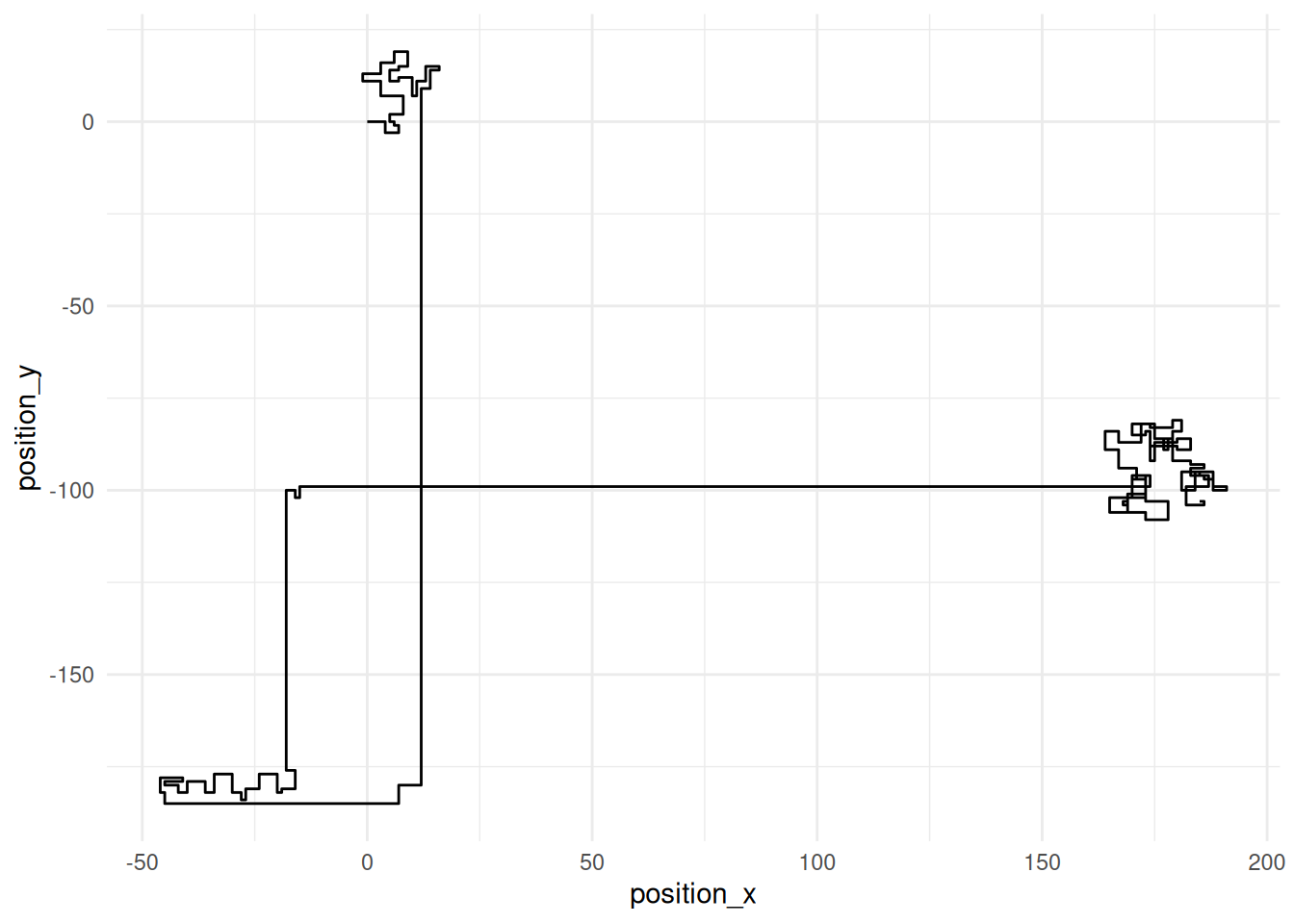
arrange(second_time)Plot
moves |>
    ggplot(mapping = aes(x = position_x, y = position_y)) +
    geom_path() +
    theme_minimal()